
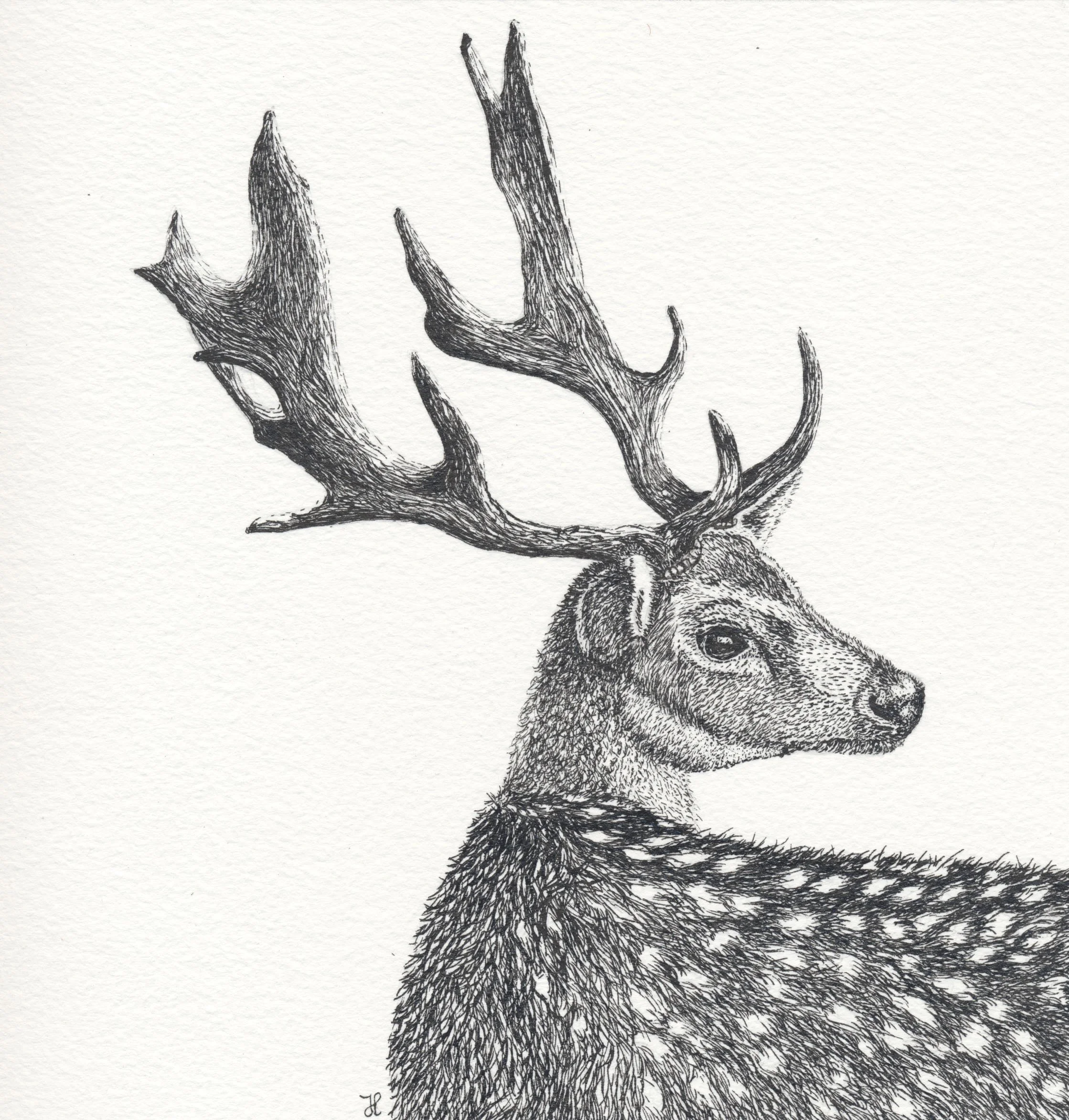
Indian ink
Working with Indian Ink and a Dip Pen
When I draw, I prefer an old, simple combination: Indian ink, a dip pen and a beautiful sheet of paper. It means working calmly and with concentration, which gives me challenge and relaxation at the same time.
A dip pen is a simple pen without an ink reservoir. What makes it so special is its flexible nib. With light pressure, I get a thin, delicate line. Press a little harder and the nib spreads open by itself, creating a broader, bolder stroke. With one and the same pen, I can control both the finest details and the strongest contours.
Because I work with black ink, I don't use colours or shades of grey to suggest depth. Instead, I rely on a few simple techniques:
Hatching: thin lines drawn close together. The closer they are, the darker an area appears.
Stippling: instead of lines, I also use countless tiny dots. It takes more time, but gives a soft, gradual transition.
Cross-hatching: a second layer of lines crossing the first, creating deeper shadows and more relief.
Varying line weight: thanks to the flexible nib, I can go from thin to thick within a single line, suggesting light and shadow without any hatching.
I often combine these techniques within one drawing, depending on what the subject needs. In this way, even in pure black and white, I can build a drawing with depth, texture and a sense of life.
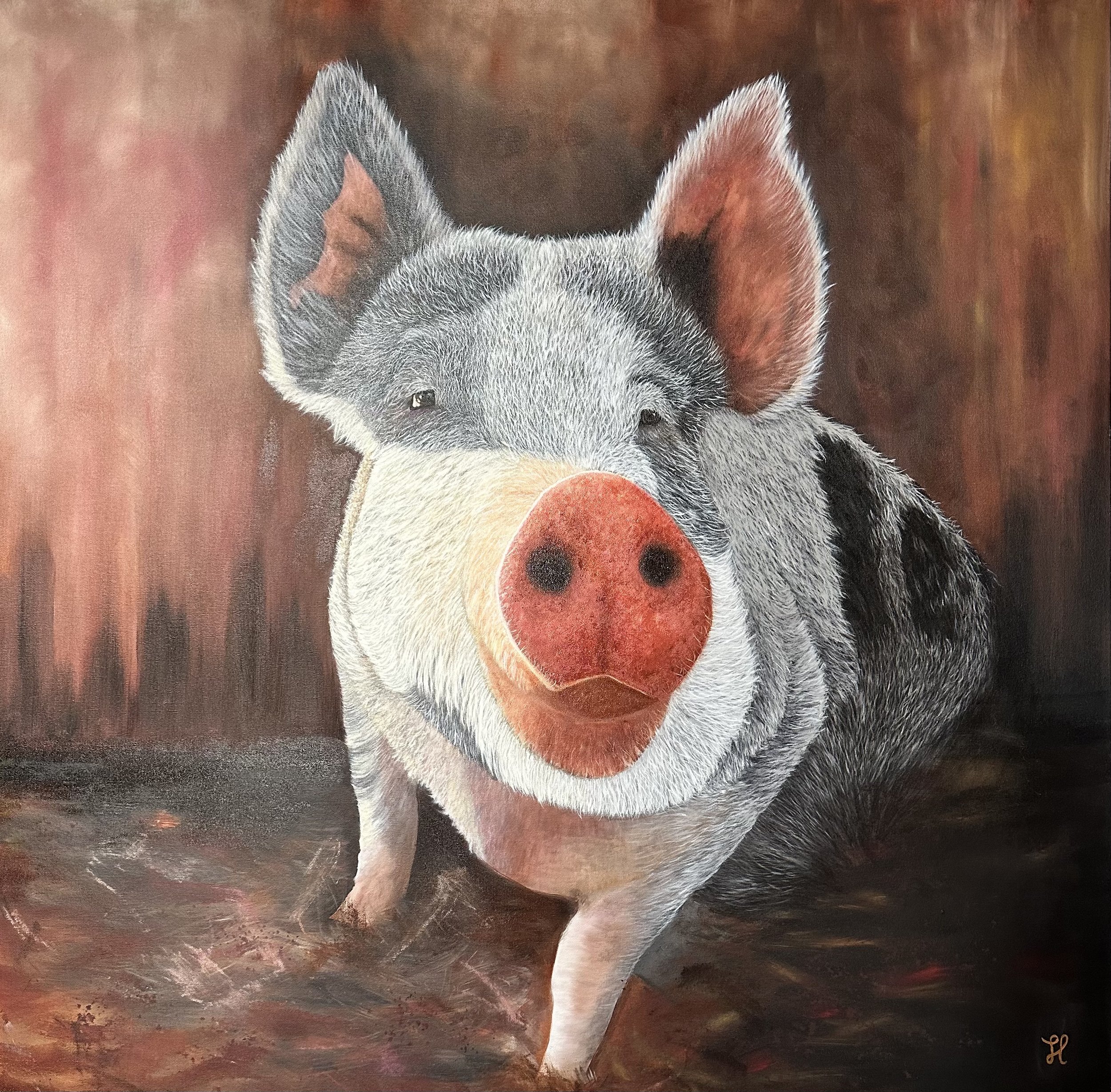
Oil Paint
My Painting Process
Oil Paint
Alongside my drawings in dip pen and Indian ink, I love painting in oil. I work with Cobra Artist, a water-mixable oil paint. It lets me make use of the qualities of oil paint, such as soft transitions between colours, while working with a paint I can thin without turpentine and use to clean my brushes.
References
Every painting begins with looking carefully. I work from several reference photos at once, so that I can capture the form, colour and character of the animal. For my own work I usually take the photos myself. Occasionally I use someone else's photo, always with the photographer's permission. For a commission, I prefer to work from several photos and videos supplied by the animal's owner, or to take them myself. That way I really get to know the animal: how it moves, how the fur or feathers catch the light, and what makes it so unique.
From First Lines to Underpainting
I paint on canvas that always receives a coat of gesso first. Then I draw the main lines onto the canvas. Next, I apply a thin wash of acrylic paint, usually in burnt umber. This warm mid-tone means I don't have to begin on a white surface, and it helps the colours work together harmoniously later on. The underpainting follows, mostly with larger brushes. At this stage everything is about the foundation: are the tonal values, the balance between light and dark, right? I also look at the direction of the fur or feathers straight away, because it determines how natural the finished painting will look.
Building Up the Layers
The following layers become more and more detailed, and I use finer and finer brushes. Working in thin layers gives the fur depth. With glazing, applying a transparent layer of thinned paint, I add warmth and glow and bring the colours into harmony.
Patience
Making an oil painting takes time. Each layer has to dry before the next can go on, and that calls for patience. But it is exactly this slow process that gives the depth and richness I'm looking for.
A Calm Background
I keep the background calm and slightly abstract. This way the eye isn't distracted, and the animal can be seen in all its beauty.
My Palette
I work with a deliberately limited palette: Payne's grey, burnt and raw umber, burnt and raw sienna, yellow ochre, titanium white and ultramarine blue. These earthy colours allow me to mix a wide range of natural shades, from warm browns to cool greys. Because I use so few colours, my paintings stay harmonious.
Finishing
Once the painting is completely dry, it receives a coat of satin varnish or cold wax. This protects the paint and lets the colours and depth show to their best advantage.
Why Oil Paint
Oil paint and pen and ink are my two favourite techniques. I love mixing and glazing, and I find realistic painting calming and deeply satisfying.
A Commissioned Painting
I also paint commissions. Do you have an animal that deserves a place on your wall? Feel free to send me a message and we'll discuss the possibilities together.